Highest RPM YouTube Niches in 2026 Ranked
By StoryBee AI Team
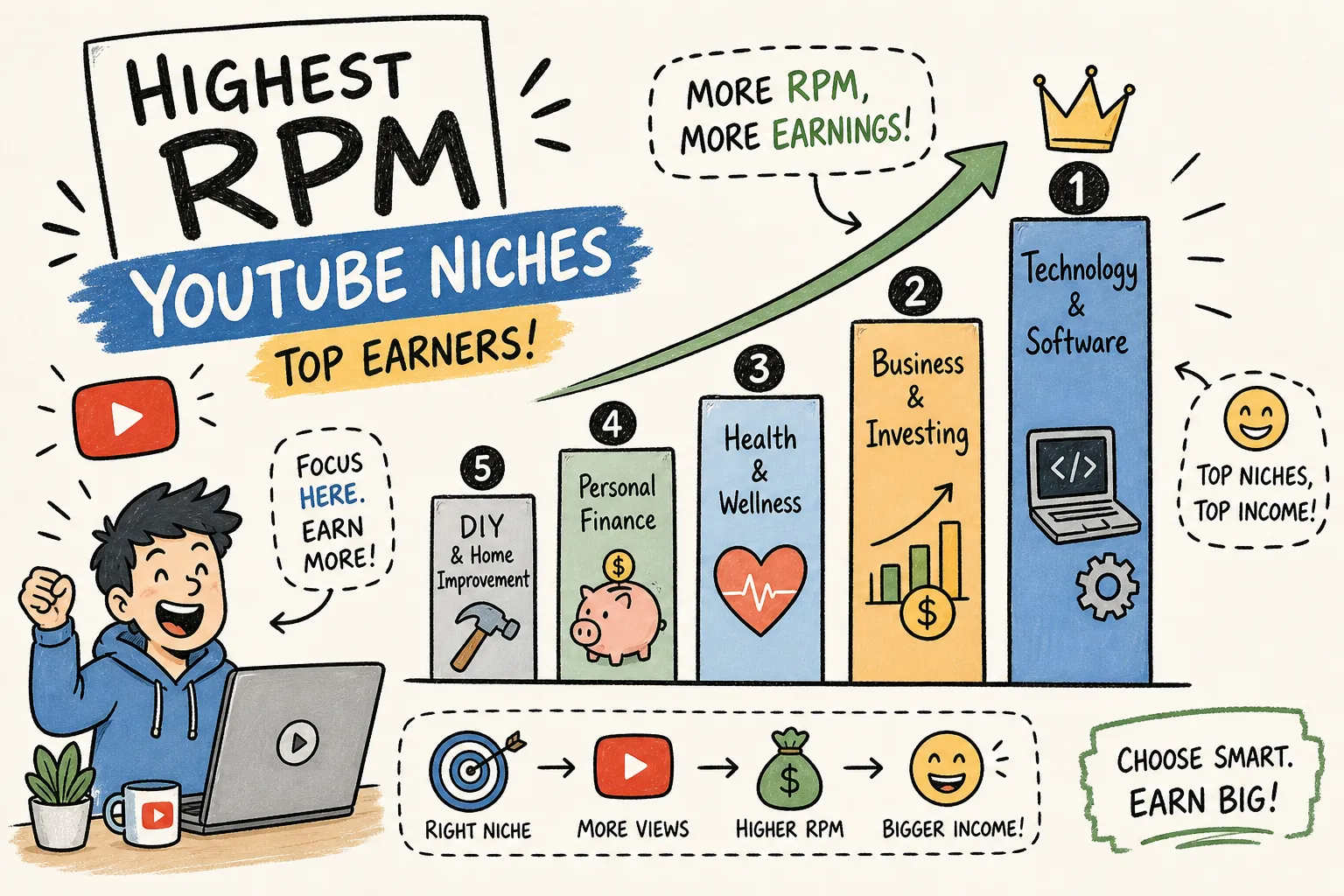
A finance channel pulling 100,000 views a month can earn $2,800 or more from ad revenue alone. A gaming channel with the exact same traffic might take home $300. Same platform, same audience size, completely different economics. That gap isn't random, and it has nothing to do with video quality or production value. It comes down to niche selection and the advertiser economics behind every dollar YouTube distributes, which is exactly why understanding high RPM YouTube niches is the most important strategic decision a creator can make before publishing a single video.
Advertisers don't bid equally across all content categories. They bid based on what a converted viewer is worth to their business. That one principle explains almost everything about why some niches consistently pay creators five to ten times more per thousand views than others. This breakdown covers real RPM and CPM ranges by niche, the advertiser logic that creates those gaps, and the content positioning moves that help creators actually capture premium rates rather than just read about them.
Identifying which high RPM YouTube niches still have accessible entry points used to require weeks of manual keyword research, analytics audits, and competitive analysis. That calculus has changed significantly, which we'll get into later. For now, start with the economics.
Why Certain Niches Command 5, 10x Higher Ad Rates
Every RPM difference traces back to one number: customer lifetime value. A credit card company earning $800 in annual fees from a single converted viewer can justify paying a $40 or $50 CPM for the right audience. A gaming peripheral brand converting viewers on a $60 headset cannot. That math determines advertiser bids, which determines what creators earn per thousand views.
The Customer Lifetime Value Equation Advertisers Use
When a bank, insurance provider, or law firm buys YouTube ad inventory, they're running the same ROI calculation every direct-response advertiser runs. If a financial services company expects one in 200 viewers to open a brokerage account worth $3,000 in annual revenue, they can bid several dollars per click without losing money. Multiply that across thousands of impressions and CPMs in the $30 to $50 range become sustainable, even rational, for that advertiser. Gaming advertisers working with $60 product margins simply don't have that room. Their bid ceiling is lower, so the floor price for every creator in that niche is lower too.
Purchase Intent Versus Passive Entertainment Audiences
Audience intent is the second driver. Someone watching a video titled "best rewards credit cards for small business" is actively in a decision-making process. That viewer is far more valuable to a credit card issuer than someone watching a gaming playthrough for entertainment. High-CPM advertisers target intent-driven audiences because those viewers convert at meaningfully higher rates, which justifies the premium. Entertainment and gaming audiences are large, but they're browsing rather than deciding. That distinction is why high RPM YouTube niches and passive-entertainment niches occupy entirely separate economic universes on the platform.
High RPM YouTube Niches in 2026: Real RPM and CPM Ranges
Before looking at the numbers, one clarification matters for setting realistic expectations. CPM is what advertisers pay per 1,000 ad impressions. RPM is what the creator keeps after YouTube's revenue share, invalid traffic deductions, and other adjustments. RPM is always lower than CPM, and it's the number that actually shows up in your bank account.
Finance, Insurance, and Real Estate: The Top-Tier Earners
Finance and investing sits at the top of every major benchmark, including data compiled from creator-disclosed YouTube Studio accounts and industry trackers like Influencer Marketing Hub, with RPM ranging from $8 to $35 and CPM often reaching $50 or higher for premium U.S. audiences. Insurance performs in a similar range, with RPM between $9 and $40, making it one of the strongest performers even within the finance category.
Real estate typically produces $8 to $28 RPM, driven by advertiser demand from mortgage lenders, property platforms, and investment services. All three categories share the same structural advantage: high customer lifetime value, fierce direct-response advertiser competition, and audiences actively researching major financial decisions.
Legal, Tech, and B2B: The Underrated Premium Category
Legal content consistently earns $8 to $18 RPM, a range that surprises many creators who overlook the niche because of its perceived complexity. Law firms pay aggressively for intent-driven audiences because a single personal injury or bankruptcy case can be worth tens of thousands in fees. Tech and software content performs well in the $4 to $18 RPM range, with the strongest numbers coming from B2B software reviews and SaaS-adjacent content where enterprise buyers are evaluating tools with large annual contract values. Business and marketing content typically earns $3 to $17 RPM, approaching tech-level rates when the content targets decision-makers rather than general audiences.
Health and Education: Strong When the Sub-Niche Is Right
Health and wellness earns $2 to $14 RPM, and education and how-to content lands between $2 and $12 RPM on average. Both categories look modest at the midpoint, but RPM rises sharply within specific sub-niches. Health content focused on insurance, supplements, or medical decision-making pulls higher advertiser bids than general fitness content. Education content targeting career transitions, test preparation, or software training earns meaningfully more than broad tutorial content. Across every category, the same pattern holds: the more the sub-topic connects to a high-value purchase decision, the stronger the RPM.
What Real Creator Earnings Tell You That Benchmarks Don't
Benchmark tables give you a range. Creator-reported numbers show the real variance inside a niche, which matters more when you're planning a channel strategy.
Creator Case Studies: What Top Channels Actually Earn
Joshua Mayo, a well-documented finance creator, has publicly reported RPM swings from $6 to $29.30 within a single month on the same channel. That range illustrates how much seasonality, video topic, and advertiser demand cycles affect earnings even within a high-performing niche.
Ali Abdaal started at $0.85 RPM in the early stages of his channel and grew to $18 RPM as his audience matured and attracted more premium advertisers. His trajectory reflects a broader pattern across education and business content: RPM improves as the audience becomes more commercially valuable over time. Within finance specifically, credit card review sub-niches are among the highest-performing areas, with top creators reporting $36 to $46 RPM, well above the general finance average.
Why Your Audience's Location Affects RPM Almost as Much as Your Niche
A U.S.-based finance audience can produce $20 or more RPM. The same content serving a Southeast Asian audience in the same niche might yield $3 to $5 RPM, sometimes less. Creator earnings data aggregated across hundreds of YouTube Studio accounts shows U.S. audiences generating roughly $8.50 RPM while South Asian audiences averaged $0.40 to $0.55, a gap of 15 to 20 times. This isn't about content quality or engagement.
It's about where advertisers want their budget allocated. The U.S. market carries the highest advertiser competition, the strongest consumer purchasing power, and the deepest available ad inventory. For creators targeting high RPM YouTube niches, building a U.S.-centric audience is a strategic decision, not just a distribution preference.
Finding Validated High-RPM Opportunities Without Doing It Manually
Most creators pick a niche based on what they already watch or what's trending on their feed. Neither approach accounts for RPM potential, advertiser demand, or keyword competition at the same time. The result is channels built in niches that feel familiar but perform poorly on the monetization metrics that actually matter.
Why Manual Niche Research Leaves Money on the Table
Manual research across YouTube Studio, Google Trends, and keyword tools is possible. It's also time-consuming, fragmented, and leaves significant blind spots around advertiser demand signals and RPM potential by sub-niche. Creators who research manually often find broad niche data but miss the specific sub-angle within finance, legal, or tech that would actually produce top-tier RPM.
The difference between "personal finance" and "credit card rewards for small business owners" isn't obvious from a keyword tool alone. Connecting advertiser vertical data with audience intent signals and competitive density requires a research workflow most creators don't have time to build from scratch.
How StoryBee's Niche Finder Surfaces High-RPM Opportunities Automatically
StoryBee's built-in viral niche finder was designed specifically to close that research gap. It surfaces high RPM YouTube topics, low-competition keyword angles, and trending story formats in one place, so creators can validate a niche's monetization potential before investing any production time. Rather than guessing which sub-niche within finance or legal pays well, you get signal on advertiser demand, topic saturation, and trending angles simultaneously. For a faceless channel operator building in one of the most profitable YouTube niches, starting with validated data rather than intuition is the difference between a channel earning $4 RPM and one earning $18. The research step isn't optional, it's where channel revenue is determined before a single video is scripted.
How to Position Your Content to Capture Premium Rates
Knowing which niches pay well is only the starting point. Capturing those rates requires deliberate content positioning, because ad revenue isn't distributed equally even within high-RPM categories.
Sub-Niche Targeting Beats Broad Category Selection Every Time
Broad "finance" content earns less than "credit card rewards for small business owners" because the audience is more specific and the advertiser pool competing for that audience is more concentrated. Specificity attracts higher-intent viewers, which draws more competitive advertiser bids, which raises RPM. The same logic applies in legal, where "immigration law for entrepreneurs" outperforms generic legal commentary, and in tech, where "B2B CRM software comparisons" earns more than broad product reviews. Going narrow within a high-RPM category is consistently the fastest path to premium rates.
Content Formats and Angles That Attract High-Intent Advertisers
Long-form content has a direct, measurable impact on RPM because longer videos support more ad placements per view, and high-RPM advertisers favor content where their message has time to land. Beyond format, writing for search intent rather than trending topics is equally important, evergreen comparison and review content ("best X for Y," "X versus Y") attracts viewers at the decision stage, which is exactly who premium advertisers pay to reach. Title and topic structure matters too: framing around the language buyers use when they're close to purchasing, rather than the language casual browsers use when exploring, consistently improves the commercial quality of your audience. RPM is a lagging indicator of that audience quality built over time, not just a reflection of your most recent video topic.
High RPM YouTube Niches: The Niche Decision Is Where Channel Income Is Made or Missed
The gap between a $3 RPM channel and a $25 RPM channel is almost never about production quality or posting frequency. It comes down to niche selection, audience intent, and content positioning. Finance, insurance, real estate, legal, and tech and B2B content all carry structural advantages among the best-paying niches for creators because the advertisers in those verticals compete for high-value customers who are actively making expensive decisions.
Validation comes before production. Picking the right niche and the right sub-angle before scripting a single video is what separates channels that grow into meaningful income from those that plateau at $2 or $3 RPM regardless of how consistently they publish.
Knowing that insurance earns $9 to $40 RPM is useful information. Knowing which specific insurance sub-topic in your market has low keyword competition and strong advertiser demand is actionable intelligence.
For creators building a high RPM YouTube channel without stitching together a dozen separate tools, StoryBee addresses both sides of that problem: niche research to pinpoint where advertiser demand actually concentrates, paired with a full content production pipeline, AI scriptwriting and multi-language dubbing, that gets validated ideas into published videos faster. The niche decision shapes everything that follows. Getting it right first is the move that compounds.