How to Do YouTube Niche Research the Right Way
By StoryBee AI Team
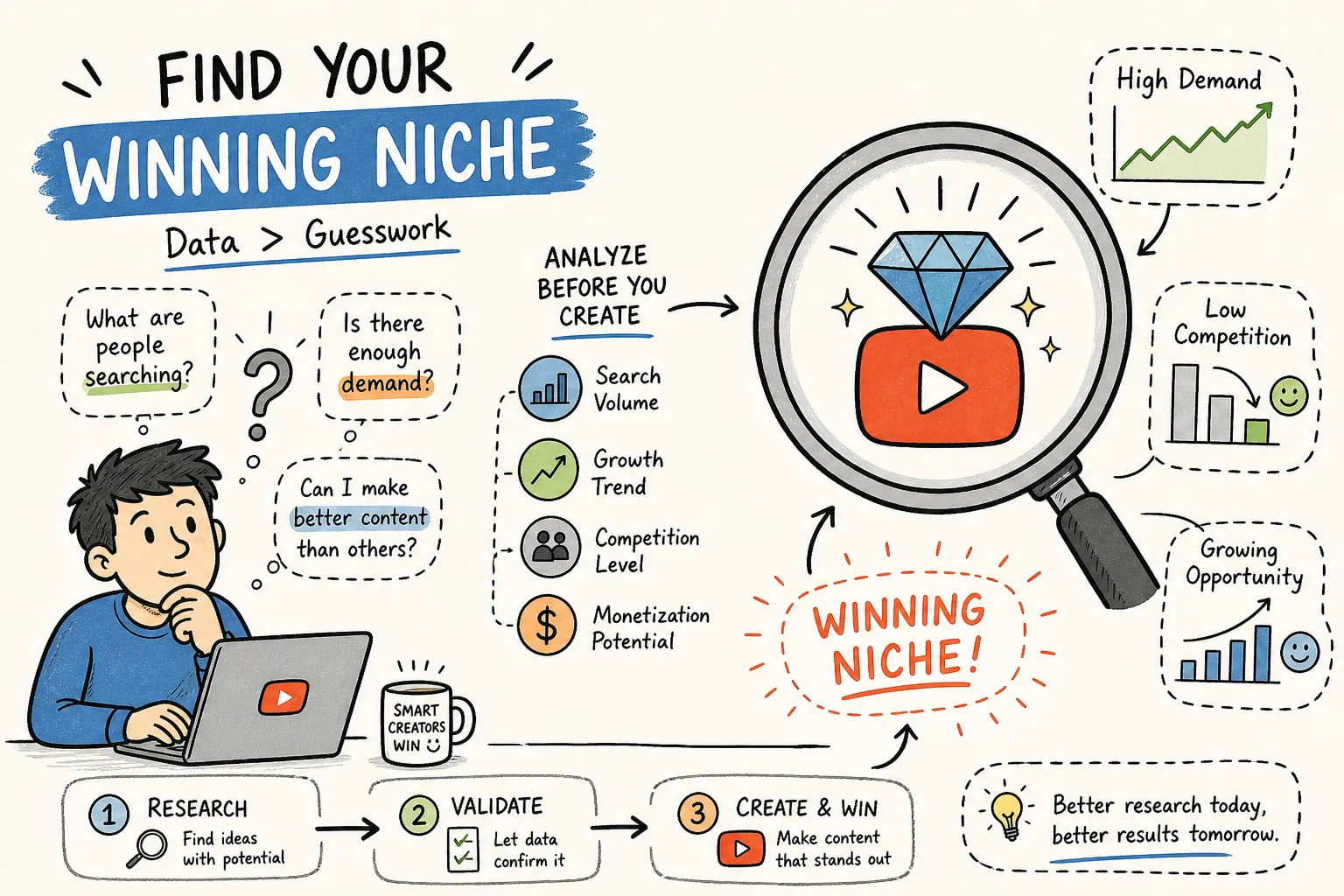
Many creators choose a niche based on what they enjoy watching rather than what the data supports. In creator community post-mortems, that instinct is frequently cited as a source of wasted months building in the wrong direction. Roughly 90% of new channels go inactive within six months, and although many blame content quality, niche selection is often identified as a critical early-stage risk. You can publish great videos in the wrong niche and still struggle to monetize.
Effective YouTube niche research is about evaluating four hard signals before you record a single frame: search demand, RPM potential, competition density, and trend direction. This guide walks through how to assess all four using both free manual sources and AI-assisted niche research tools for YouTube. StoryBee's niche research features help creators run this same workflow faster and more systematically. This article explains the full process so you understand why each step matters.
What actually defines a profitable YouTube niche
A profitable niche is not just a topic people enjoy watching. It is a topic where measurable audience demand, advertiser competition, and creator supply all align in your favor. Skipping any one of those dimensions leads to channels that grow slowly, monetize poorly, or burn out their creators before reaching scale.
The four signals every niche evaluation needs
- Search demand: Is there consistent, measurable audience interest in this topic, or is it a short-lived trend?
- RPM potential: What advertisers pay to reach this audience determines your long-term income ceiling, not just your view count.
- Competition density: How many established channels already dominate the search results, and is there room for a new channel to break through?
- Growth trajectory: Is audience interest in this niche expanding, flat, or contracting over time?
Competition density matters more than channel count alone. A niche with 5,000 channels where the top results are dominated by million-subscriber giants is harder to crack than one with 15,000 channels where small creators regularly break through. Growth trajectory tells you whether your investment is appreciating or depreciating. A niche that is flat today may be gone within a year or two, so trend direction deserves the same scrutiny as any other signal.
Why RPM should drive your decision more than passion
CPM is what advertisers pay YouTube per 1,000 ad impressions. RPM is what creators actually receive per 1,000 views after YouTube takes its share and after accounting for views that do not serve ads. These numbers diverge significantly, and RPM is the only figure that matters for your actual earnings. A channel generating 100,000 monthly views at $15 RPM earns more than one generating 300,000 views at $4 RPM, even though the second channel has three times the traffic.
The 2026 data makes this concrete. Legal and tax education channels in the U.S. command $15 to $40 CPM.
Cybersecurity content runs $12 to $28 RPM (CPM is higher still). Even soundscapes for sleep, a simple production format, generates $10.92 RPM with roughly 20,000 channels in the space, which signals the niche has demand without overwhelming saturation. These numbers reframe niche selection from a passion decision into a strategic one.
How to do YouTube niche research manually with free tools
Before reaching for paid tools, the free manual process reveals more than most creators realize. Each of the three steps below targets a different signal: audience demand, trend momentum, and competitive headroom. Working through all three gives you a defensible read on a niche before you spend a dollar or film a frame.
Reading demand for YouTube niche research with autosuggest
YouTube's own search bar is the most underused free research tool available. Type a broad niche term and read the autocomplete suggestions closely. Those are real queries that real people are actively searching right now. Then search the topic and sort results by "View count" versus "Upload date." If older content consistently outranks fresh uploads, you are looking at a high-competition niche with strong incumbents. If recent uploads are breaking through, smaller channels have a path in. This step takes 10 to 15 minutes and requires no tools or subscriptions.
Using Google Trends to confirm momentum
Google Trends validates whether a niche is growing or fading over time. Search the core topic, switch the data source to YouTube Search, and compare 12-month versus 5-year interest. A niche with consistent upward momentum across both windows is a safer long-term bet than one with a single viral spike followed by a decline. Filter to the United States specifically when evaluating monetization relevance, because U.S. audience interest drives higher RPM than global averages.
Scanning competitor channels for gaps and outliers
Search the niche on YouTube and review the top 10 results. Note subscriber counts, upload recency, and average view performance for each channel. Pay specific attention to outlier videos where a small or mid-sized channel dramatically outperformed its normal average. Those outliers usually signal a topic angle or format that the algorithm and audience rewarded beyond expectation. Read the comments on those videos carefully: repeated questions and underserved requests are content gaps waiting to be filled by the next creator willing to address them directly.
How to estimate RPM potential before you launch
Many creators skip monetization research entirely until they are already deep into building a channel. By then, switching niches means abandoning months of work. Running RPM estimates before you launch changes that calculus entirely.
Which niches actually pay well in 2026
Finance, legal education, cybersecurity, and AI workflow tutorials are among the highest-paying niches in the U.S. in 2026, driven by advertisers competing aggressively to reach audiences that make purchasing decisions. The pattern is consistent: niches where the audience actively researches products, services, or financial choices attract premium advertiser budgets, which pushes CPM and RPM higher.
Senior digital literacy carries roughly $6.17 RPM with only about 10,000 channels in the space. Literary analysis runs $9.15 RPM with similar creator supply and 89% audience loyalty scores. These are not the flashiest niches, but the data shows they are meaningfully underserved relative to their monetization value. For anyone mapping low competition YouTube niches with strong advertiser demand, these categories deserve a close look.
Tools that surface RPM estimates without owning a channel
Third-party tools like OutlierKit, vidIQ, and NexLev provide RPM estimates derived from public channel data and advertising signals. These are directional estimates rather than exact figures, but they give new creators a meaningful baseline for comparing niche monetization potential before committing. No external tool can match the accuracy of your own YouTube Studio data once you have a channel, but for pre-launch niche comparison, these niche research tools for YouTube are worth the time. This type of multi-signal analysis, combining demand, RPM range, competition density, and trend direction, is the core of any serious YouTube niche research process, and StoryBee is built to support exactly that kind of systematic evaluation.
How StoryBee supports this entire research process
The manual process described above works. It is also slow, fragmented, and easy to do inconsistently when you are evaluating multiple niches at once. StoryBee is built for faceless YouTube creators and automation-minded operators who need validated answers fast and a clear path from research to published content.
What StoryBee surfaces for niche validation for creators
StoryBee surfaces high-RPM YouTube topics, low-competition keywords, and trending story angles in one workflow, eliminating the need to cross-reference autosuggest, Trends, competitor channels, and third-party RPM estimators separately. The platform identifies YouTube niche ideas where advertiser demand, search volume, and channel saturation align to create a viable entry point, not just popular categories already too crowded to break into. For creators running multiple channels or operating at agency scale, this is not a convenience feature; it is a structural advantage that changes how many niches can be evaluated and acted on in a given week.
Manual research vs. AI-assisted niche discovery
A thorough manual YouTube niche research session, covering autosuggest, Trends, competitor analysis, and RPM lookup, often takes several hours to do properly for a single niche. Running that process across three or four candidate niches before making a final decision multiplies the time commitment significantly. StoryBee compresses that workflow, delivering the same core signals: demand score, estimated RPM range, competition density, and trend direction. For creators serious about building channels that actually monetize, that compression is the difference between testing one niche per month and testing several per week.
Validating your niche before you film a single video
Even after the research phase, a final validation step protects you from committing to a niche that looks good on paper but does not have the depth to support a long-term channel.
The competition check that tells you if there's room to win
Search the niche on YouTube and study the top-ranking channels carefully. If the results are dominated by channels with millions of subscribers publishing dozens of videos per week, the entry cost is high. If smaller channels are ranking with uploads from the last 30 days, the niche has room. Treat the 50,000-subscriber mark as a rough rule of thumb, not a hard line: what matters is whether new entrants are visibly breaking through at all. Look specifically for small-channel outliers that broke through with strong performance. Those are proof the algorithm rewards the right content angle regardless of channel age or size, which means sharp positioning can compete even on a new channel.
Mapping your first 10 video ideas as the final test
Before committing to a niche, list 10 distinct, non-overlapping video ideas that fit without repeating the same angle. If you cannot generate 10 clearly differentiated topics, the niche is either too narrow or not a strong content fit for the audience you are targeting. If 10 ideas flow easily and each has a clear search hook, that is a reliable signal the niche has enough depth to support a channel long-term. This exercise takes 20 minutes and often reveals more about a niche's true viability than any research tool. A niche that passes the data checks but fails this ideation test is still the wrong niche.
Build your YouTube niche research into a repeatable system
YouTube niche research is not a one-time decision. It is the strategic foundation every publishing decision is built on. The workflow is consistent: define your four signals, run the manual checks, estimate RPM, use StoryBee to accelerate and organize the analysis, and confirm the niche passes both the competition and content-depth tests before you launch.
Creators who treat this process seriously before they start are the ones who build channels that actually monetize.
The niches that look exciting are rarely the ones that perform. The ones that pay are often quieter, more specific, and just underserved enough that a new channel with the right positioning can establish itself before the space fills up. That window closes as more creators run the same research, which is why the speed and consistency of your YouTube niche research process matters as much as the quality of any single decision.
Start your YouTube niche research with StoryBee and see which high-RPM niches still have room. The data is already there; the only question is whether you find the opportunity before someone else does.